Menopause hair · Evidence led
HRT and hair loss: help, harm or coincidence?
Hormone replacement therapy is for menopause symptoms, not a stand alone hair treatment. Here is what we know, what we do not and how to review changes safely.
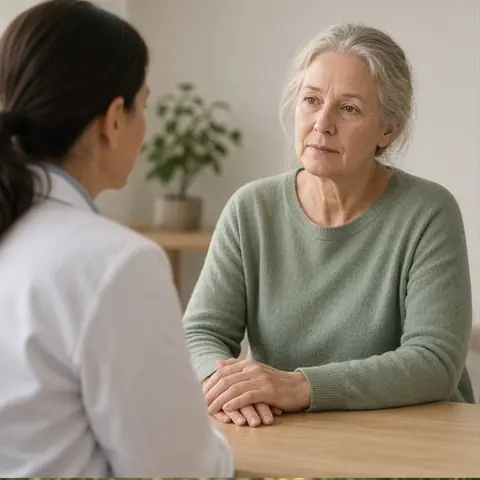
HRT is offered for menopause symptoms such as hot flushes, not as a treatment for hair loss on its own. Some women notice their hair feels different after starting or changing HRT, in either direction. Timing alone does not prove the treatment caused the change.
I heard both stories in the same week more than once: "HRT saved my hair" and "HRT made it worse." Both women deserved a slower look at dates, other causes and what the guidance actually says. This article is that slower look. It is not personal medical advice and it is not a reason to start, stop or switch HRT without your prescriber. For the wider treatment list, see our menopause hair loss treatments guide.
Key points
- NICE guidance recommends HRT for menopause symptoms after a discussion of benefits and risks, not as a hair treatment.[1]
- Oestrogen influences hair follicles, which is not the same as proving HRT regrows hair.[2][3]
- Hair changes around the same years have many other causes, including pattern thinning, iron and shedding after a trigger.[4][5]
- Never start, stop or change HRT on the basis of an article.[1]
- A simple timeline helps your prescriber review what changed and when.
Why timing is not proof
Menopause, perimenopause and the months after a new prescription often overlap. Female pattern hair loss becomes more common with age and after menopause.[5][6] Extra shedding can follow illness, stress or a diet change two to four months later.[7][8] Heavy periods before HRT starts can lower iron.[9] If hair changes a few months after a prescription, all of those things may still be in play.
The hair cycle adds another delay. A shed you notice now often began with a trigger months earlier.[7] Starting HRT in the same window can look like cause and effect when it is coincidence.
Oestrogen does influence how follicles grow. A review of hormones and the hair follicle describes a complex relationship with oestrogens, androgens and other signals.[2] Another review asked whether hormonal change in midlife produces a separate hair crisis and pointed to several overlapping factors, not one switch you can flip with a prescription.[3] Women's Health Concern notes that hormonal change around menopause can play a part in hair thinning, while listing other causes beside it.[4]
That biology explains why people hope HRT will help hair. It does not turn HRT into a proven hair treatment.
What the guidance says
NICE guideline NG23 covers identification and management of menopause. It recommends discussing HRT for symptoms such as hot flushes and night sweats, with clear information on benefits and risks. It covers women who have a womb (who usually need a progestogen as well as oestrogen) and women who do not.[1] It is not a hair loss guideline and it does not recommend HRT as a stand alone treatment for thinning hair.
The British Association of Dermatologists discusses licensed and commonly used options for female pattern hair loss, with topical minoxidil as a main medical treatment. HRT is not presented there as a standard hair therapy.[10]
Some women do notice their hair feels thicker, shinier or easier to manage after HRT settles their sleep and flushes. Better sleep and less strain can matter for shedding.[7][8] Others notice more hair in the brush or a change in texture. Individual stories are real. They are not a substitute for trials that set out to measure hair.
If you are considering minoxidil as well as HRT, those are separate conversations: one with your prescriber about hormones and one with a pharmacist or clinician about minoxidil. Do not add or stop either based on this page.
Other causes to review first
Before you blame or credit HRT, work through the same checklist you would use without it.
- A slowly wider parting and finer hair on top often fit female pattern hair loss, which can continue whether or not you take HRT.[10][6]
- A sudden all over shed 2 to 4 months after illness, surgery, stress or a diet change often fits telogen effluvium.[7][11]
- Low ferritin after heavy periods is common in perimenopause.[12][13][9] See ferritin and hair loss.
- Thyroid changes can affect hair and some symptoms overlap with menopause.[4]
- A new medicine other than HRT may be the more likely trigger. Never stop a prescribed medicine yourself.[14]
- Heat, colour and tight styles cause breakage that can look like loss.[4]
Our starting guide to menopause hair loss and hair thinning after 50 walk through these in more detail.
Reviewing changes with your prescriber
Go to the review with facts rather than fear.
- The date you started HRT, or the date of the last change in type or dose
- When you first noticed the hair change
- Whether the change is all over shedding, a wider parting or short broken pieces
- Other events 2 to 4 months before: illness, stress, diet, a new medicine
- Your other menopause symptoms and whether they improved
- Every supplement, including biotin, which can affect some blood tests[15][16]
Questions that help:
- Could this timing fit the hair cycle rather than the prescription?
- Are there tests worth considering, such as ferritin or thyroid function, based on my history?[4][1]
- If we discuss a change in HRT, what are the benefits and risks for my symptoms, not only for my hair?[1]
- Who should I see if the pattern looks like female pattern hair loss rather than a hormone side effect?[10]
There is no HRT regimen this article can recommend for hair. Type, dose, tablets, patches or gel and whether you need a progestogen depend on your body and your history.[1] Those details are for a qualified prescriber.
Never change treatment alone
Stopping HRT suddenly can bring hot flushes, poor sleep and other symptoms back. Starting someone else's unused patches or increasing a dose yourself is unsafe. If you are worried, contact the GP, menopause clinic or specialist who prescribed your treatment. If you cannot reach them and you have severe symptoms, use NHS urgent advice routes rather than an online forum.
HRT also has benefits and risks that go well beyond hair, which NICE asks clinicians to discuss.[1] Hair is one part of how you feel. It should not be the only reason a treatment is judged.
Who to see
You are happy with HRT and your hair change is gradual: a qualified trichologist or experienced hairdresser can assess the pattern while you stay on the treatment your prescriber advised.
You think HRT may be linked to a sudden shed, or you want to change treatment: contact your prescriber. See your GP promptly for warning signs.[14][1]
See your GP promptly if you notice
- Sudden or patchy hair loss
- A hairline moving back, or eyebrow loss
- A sore, burning, red or scaly scalp
- Chest pain, a swollen leg, sudden breathlessness or severe new symptoms on HRT: seek urgent medical help
Our free 7 day hair kindness checklist can help you gather a medicines list and a baseline photo before that conversation.
Questions, written down
The Menopause Hair Guide includes a GP appointment script and a treatments overview that states plainly what HRT is and is not for. Take it to the appointment if it helps you keep the questions straight.
Keep reading
- Menopause hair loss treatments: an evidence guide
- Minoxidil and menopause: questions before starting
- Menopause hair loss: a clear starting point
Frequently asked questions
Does HRT help hair loss?
HRT is not licensed or recommended as a treatment for hair loss on its own. It is offered for menopause symptoms such as hot flushes after a discussion of benefits and risks. Some women notice their hair feels different after starting HRT, in either direction. That observation is not the same as proof that HRT treats or causes hair loss.
Can HRT cause hair thinning?
Some women report more shedding or a change in texture after starting or switching HRT. Other things often happen at the same time, including the menopause transition itself, stress, iron changes and new medicines. A prescriber can help you look at the timeline rather than stopping treatment on a guess.
Which type of HRT is best for hair?
There is no HRT product licensed as a hair treatment and no good evidence that one type should be chosen only for hair. The type, dose and whether you need a progestogen depend on your symptoms, whether you have a womb and your medical history. Those choices belong with your prescriber.
Should I stop HRT if my hair is shedding?
Do not stop or change HRT on your own. Contact the clinician who prescribed it. Sudden stops can bring symptoms back and the hair change may have another cause. Take a simple timeline of when treatment started and when your hair changed.
This article is general education, not medical advice. It cannot diagnose or treat any condition. Speak to a qualified hair expert or your GP about hair changes and seek medical help promptly for the warning signs above.
Sources
Sources were checked on 8 November 2026. Numbers in the text link to this list.
- National Institute for Health and Care Excellence. Menopause: identification and management. NICE guideline NG23. Last reviewed 15 April 2026. Source
- Grymowicz M, Rudnicka E, Podfigurna A, Napierala P, Smolarczyk R, Smolarczyk K, Meczekalski B. Hormonal effects on hair follicles. Int J Mol Sci. 2020;21(15):5342. PMID: 32731328. Source
- Mirmirani P. Hormonal changes in menopause: do they contribute to a ‘midlife hair crisis’ in women? Br J Dermatol. 2011;165 Suppl 3:7 to 11. PMID: 22171679. Source
- Women’s Health Concern (patient arm of the British Menopause Society). Menopausal hair loss: more than ‘a bad hair day’. Factsheet. November 2025. Source
- Birch MP, Messenger JF, Messenger AG. Hair density, hair diameter and the prevalence of female pattern hair loss. Br J Dermatol. 2001;144(2):297 to 304. PMID: 11251562. Source
- Sheffield Teaching Hospitals NHS Foundation Trust. Female pattern hair loss. Patient information leaflet PIL1150. Source
- American Academy of Dermatology. Do you have hair loss or hair shedding?. Source
- Headington JT. Telogen effluvium: new concepts and review. Arch Dermatol. 1993;129(3):356 to 363. PMID: 8447677. Source
- NHS. Iron. Page last reviewed 3 August 2020. Source
- British Association of Dermatologists and British Hair and Nail Society. Hair loss: female pattern (androgenetic alopecia). Patient Information Leaflet. Updated October 2024. Next review October 2027. Source
- NHS Devon (MyHealth Devon). Alopecia (hair loss). Source
- Kantor J, Kessler LJ, Brooks DG, Cotsarelis G. Decreased serum ferritin is associated with alopecia in women. J Invest Dermatol. 2003;121(5):985 to 988. PMID: 14708596. Source
- Trost LB, Bergfeld WF, Calogeras E. The diagnosis and treatment of iron deficiency and its potential relationship to hair loss. J Am Acad Dermatol. 2006. doi: 10.1016/j.jaad.2005.11.1104. PMID: 16635664. Source
- NHS. Hair loss. Page last reviewed 24 January 2024. Next review due 24 January 2027. Source
- US Food and Drug Administration. Testing for biotin interference in in vitro diagnostic devices. Guidance for industry and FDA staff. Source
- Manchester University NHS Foundation Trust. Potential for biotin interference in immunoassays. Laboratory notice. Source