Menopause hair · Evidence led
Choosing shampoo for menopausal hair
The best shampoo for menopause hair is the one that suits your scalp and texture, not the one with the biggest promise on the front of the bottle.
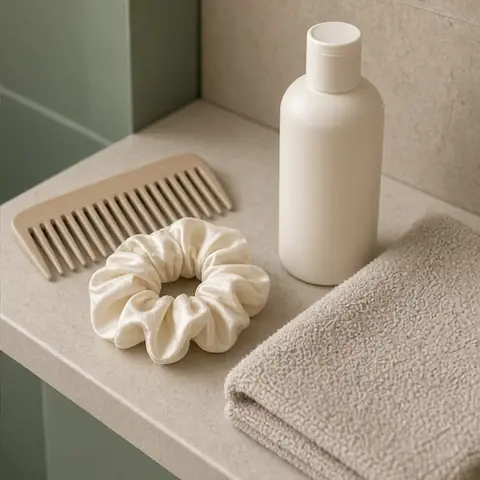
There is no single best shampoo for menopause hair. The right wash is the one that keeps your scalp comfortable, respects your texture and does not promise to treat a cause it cannot reach.
I watched a lot of money leave the consultation room and go straight to a "thickening" shelf. Sometimes the new bottle made hair feel nicer. Sometimes it made no difference at all. Almost never did it change the diagnosis underneath. This guide explains how to choose, what labels can and cannot tell you and when you need more than shampoo. For the full routine, see our gentle menopause hair care routine.
Key points
- Match the wash to your scalp and texture, not to a miracle claim.[1][2]
- Thickening shampoos may help hair look fuller or reduce breakage. They cannot treat pattern hair loss.[2]
- Women's Health Concern mentions thickening shampoos and conditioners as a way to improve appearance.[1]
- A sore, itchy, red or scaly scalp needs a GP rather than another bottle.[1]
- Everyday care still matters: shampoo the scalp, condition the lengths and handle wet hair gently.
Scalp needs versus cosmetic volume
Start with how your scalp feels the day after you wash.
- Tight, squeaky or itchy can mean the wash is too harsh or too stripping for you.
- Limp roots and a comfortable scalp may do better with a lighter, volumising wash and less conditioner near the roots.
- Dry lengths with a balanced scalp often need a gentle shampoo and a richer conditioner from mid length to ends.
- Flakes, persistent itch, soreness or redness point to the skin itself and should not be treated with a long line of new products first.[1]
Cosmetic volume is a separate job. Fine hair can look flatter around menopause as diameter falls with age.[3][4] A volumising shampoo coats the fibre or removes residue so strands separate and look fuller. That can be genuinely useful on a Tuesday morning. It is not the same as slowing female pattern hair loss.[2]
If you are not sure whether you are shedding, thinning or breaking, read shedding, thinning or breakage before you spend more on a wash.
Ingredients and labels
Labels are written to sell as well as to inform. A few translations help.
"For thinning hair" or "hair loss shampoo". Often this means the product aims to make hair look thicker or to reduce breakage. The American Academy of Dermatology says these shampoos may help hair hold moisture, so it looks thicker, or reduce breakage. They cannot grow hair or stop pattern loss.[2]
"Thickening" or "volumising". These usually describe a cosmetic effect. Women's Health Concern lists thickening shampoos and conditioners among things that may improve how menopausal hair looks.[1]
"Sulphate free" or "gentle". Some people find milder detergents more comfortable, especially if the scalp feels dry. Comfort is the test, not the marketing phrase.
"Natural", "hormone balancing" or "oestrogen support". Shampoo sits on the scalp for a short time. It is not a hormone treatment. HRT, when it is used, is a prescribed medicine for menopause symptoms and is not a hair wash.[5] Be wary of bottles that blur that line.
Essential oils. Rosemary oil has one small trial against a 2% minoxidil lotion in people with androgenetic alopecia.[6] That is limited evidence and it is not a reason to put neat essential oil on a sore scalp. Avoid oils on broken or irritated skin.
You do not need a long ingredient lecture to shop well. If the claim sounds like a treatment for a medical cause, it is asking too much of a wash.
Texture specific choices
Hair around menopause often feels drier or less predictable and grey hair can behave differently from pigmented hair.[7]
Straight or wavy fine hair. A lightweight wash, conditioner kept off the roots and a wide tooth comb on wet lengths can reduce flattening and breakage.
Curly hair. Curls often need more conditioning on the lengths and less frequent shampooing of the scalp than fine straight hair, as long as the scalp stays comfortable. Gentle detangling and a microfibre towel or old T-shirt beat rough rubbing.
Coily hair and locs. The scalp still needs cleansing. The lengths often need moisture and very little manipulation. Tight styles at the hairline deserve a second look if edges are thinning. Persistent bumps, tenderness or breakage at the crown should be checked, because they can be early signs of a scarring condition.[8]
Colour treated hair. Use a wash your colourist is happy with and be kinder with heat. Colour does not treat thinning, though a skilful tint can make the parting less obvious.[1]
There is no universal washing timetable. Wash as often as your scalp stays comfortable. After exercise, a gentle wash can be kinder than leaving sweat on an itchy scalp. Our routine article walks through drying, ties and cuts as well.
What shampoo cannot treat
Shampoo cannot:
- reverse female pattern hair loss[9][2]
- correct iron deficiency or a thyroid problem[1][10]
- replace a licensed medical option such as topical minoxidil if you and a professional decide that is appropriate[11]
- diagnose a sore, scaly or patchy scalp[12]
If the change is a slowly wider parting, read about treatments and what the evidence shows. If you feel tired or have heavy periods, ask your GP about causes including ferritin and iron. If you want a medical option explained without sales pressure, see minoxidil and menopause.
A good cut, a different parting, colour, fibres or a topper can also change how you feel day to day. These are confidence tools, not treatments and there is no shame in using them.[1]
A simple budget checklist
- Does my scalp feel comfortable the next day?
- Do I see fewer short broken pieces after a gentler wash and blot dry?
- Am I buying this for how hair looks, or because the label hinted at a cure?
- Can I finish the bottle before I try another, so I know what actually changed?
- Have I looked at heat, ties and colour at the same time?[1]
- If my scalp is sore, red or scaly, have I arranged proper advice instead of another product?[1]
Price is a poor guide. An inexpensive gentle wash used kindly often beats an expensive "hair loss" bottle used roughly. Spend first on a hair expert appointment if no one has looked at your scalp yet.
Our free 7 day hair kindness checklist includes a gentle wash day and a heat free day, which is a low cost way to test what your hair does when you stop fighting it.
Who to see
Comfortable scalp and gradual cosmetic change: an experienced hairdresser or qualified trichologist can help you choose a wash and a cut that suit thinning hair.
Itch, pain, scale, patches or sudden loss: see your GP rather than changing shampoo again.[1][12]
See your GP promptly if you notice
- A sore, burning, red or scaly scalp
- Sudden or patchy hair loss
- Spreading breakage at the crown with bumps or tenderness
Beyond the bathroom shelf
The Menopause Hair Guide includes routines for every texture, an ingredient label decoder and weekly action cards so shampoo sits in a wider plan, not on a pedestal.
Keep reading
- A gentle haircare routine for midlife
- Menopause hair loss treatments: an evidence guide
- Shedding, thinning or breakage: what is different?
Frequently asked questions
What is the best shampoo for menopausal hair loss?
There is no single best bottle. Choose for your scalp first: comfortable, not tight or itchy after washing. Thickening or volumising shampoos may help hair look fuller or reduce breakage. They cannot treat female pattern hair loss or replace a medical option if you need one.
Do thickening shampoos work?
They can change how hair looks and feels. The American Academy of Dermatology notes that hair loss shampoos may help hair hold moisture, so it looks thicker, or reduce breakage. They cannot grow new hair or stop pattern thinning. Women's Health Concern also mentions thickening products as a way to improve appearance.
How often should I wash thinning hair in menopause?
As often as your scalp stays comfortable. Some women do better with more frequent gentle washes, others with fewer. Texture, exercise, oiliness and whether you wear styles that are washed less often all matter. There is no universal schedule.
Can shampoo cause hair shedding in menopause?
A harsh wash or rough towel drying can increase breakage, which looks like extra hair in the plughole. True shedding comes from the root and has other causes. If a product leaves your scalp sore, itchy or flaky, stop it and seek advice if the skin does not settle.
This article is general education, not medical advice. It cannot diagnose or treat any condition. Speak to a qualified hair expert or your GP about hair changes and seek medical help promptly for the warning signs above.
Sources
Sources were checked on 8 November 2026. Numbers in the text link to this list.
- Women’s Health Concern (patient arm of the British Menopause Society). Menopausal hair loss: more than ‘a bad hair day’. Factsheet. November 2025. Source
- American Academy of Dermatology. Thinning hair and hair loss: could it be female pattern hair loss? Last updated 13 December 2022. Source
- Birch MP, Messenger JF, Messenger AG. Hair density, hair diameter and the prevalence of female pattern hair loss. Br J Dermatol. 2001;144(2):297 to 304. PMID: 11251562. Source
- Mirmirani P. Hormonal changes in menopause: do they contribute to a ‘midlife hair crisis’ in women? Br J Dermatol. 2011;165 Suppl 3:7 to 11. PMID: 22171679. Source
- National Institute for Health and Care Excellence. Menopause: identification and management. NICE guideline NG23. Last reviewed 15 April 2026. Source
- Panahi Y, et al. Rosemary oil vs minoxidil 2% for the treatment of androgenetic alopecia: a randomized comparative trial. Skinmed. 2015;13(1):15 to 21. PMID: 25842469. Source
- Ali I, Wojnarowska F. Physiological changes in scalp, facial and body hair after the menopause: a cross-sectional population-based study of subjective changes. Br J Dermatol. 2011;164(3):508 to 513. PMID: 21128905. Source
- American Academy of Dermatology. Hair loss types: Central centrifugal cicatricial alopecia signs and symptoms. Updated 14 March 2022. Source
- British Association of Dermatologists and British Hair and Nail Society. Hair loss: female pattern (androgenetic alopecia). Patient Information Leaflet. Updated October 2024. Next review October 2027. Source
- Trost LB, Bergfeld WF, Calogeras E. The diagnosis and treatment of iron deficiency and its potential relationship to hair loss. J Am Acad Dermatol. 2006. doi: 10.1016/j.jaad.2005.11.1104. PMID: 16635664. Source
- van Zuuren EJ, Fedorowicz Z, Schoones J. Interventions for female pattern hair loss. Cochrane Database Syst Rev. 2016;(5):CD007628. PMID: 27225981. Source
- NHS. Hair loss. Page last reviewed 24 January 2024. Next review due 24 January 2027. Source